I was in a steering committee last month where the System Integrator's status report had been amber for six consecutive months. Nobody in the room asked why it had not turned red. The SI walked through the slides. Three risks were noted. Two were "being managed." The third was "in scope for next month's review." The board thanked the team. The meeting ended on time.
The programme budget was £40m. The programme was failing.
And the governance was working exactly as designed.
This is the scene playing out, with minor variations, across the market right now. The casting changes. The script does not.
The Resurgence and the Risk
Despite what is going on in the world around us, capital has begun to be freed up. Private Equity houses that have been sitting on dry powder are deploying it into portfolio companies under acute pressure to show value creation before the next exit window. At the same time, the 2027 cut-off for SAP ECC maintenance is forcing global, matrixed enterprises into S/4HANA migrations they have been deferring for years.
The result is a transformation appetite I have not seen since 2019. Programmes are being signed off across PE portfolios and matrixed enterprises in volumes the market has not seen in the past few turbulent years.
Many of these will fail. Industry analyses have consistently put large-scale ERP failure rates above 70 percent, where "failure" means missing the deadline, the budget, or the intended business outcome.
Technology is rarely the reason. These programmes fail at governance. And by the time the failure becomes visible, the value-creation window has already passed.
The Illusion of Control
When a board signs off on a major ERP implementation or a complex carve-out, they surround it with the visible machinery of control. A Steering Committee. A PMO. A tier-one System Integrator promising seamless delivery. Status updates on a steady cadence. RAG indicators. Escalation paths.
The structures exist. They look like governance. They are, in many cases, theatre.
The SI directs. The PMO manages the stagecraft. The board watches. The script is the status update, with its familiar rhythm: progress in green, complications in amber, nothing in red. Nobody is lying. The play is simply running on the assumption that the audience does not need to interrupt. And without strong, independent leadership on the client side, the audience rarely does.
Three Patterns That Tell You the Theatre Is in Session
If you are seeing more than one of these in your programme, the governance is performing, not functioning.
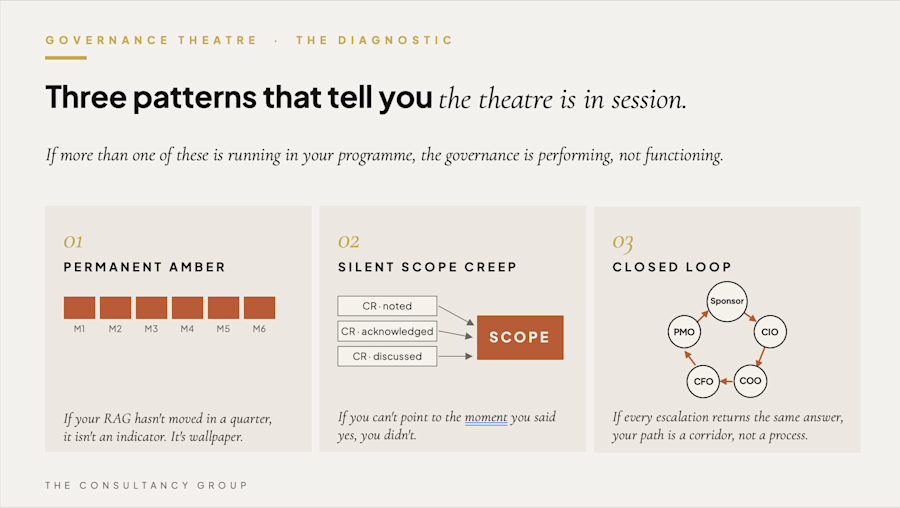
Permanent Amber. A workstream is amber for two months. Then three. Then six. It is "being managed." Nobody calls red, because red would force action, escalation, and commercial conversations with the SI. Amber is permanent because amber is convenient. If your RAG hasn't moved in a quarter, it isn't an indicator. It's wallpaper.
Silent Scope Creep. The SI raises a change request. The PMO logs it. The Steering Committee reviews it. The minutes say "discussed and acknowledged." The change is now in scope. Nobody quite remembers when the decision to accept it was made. If you cannot point to the moment you said yes, you didn't.
Closed-Loop Escalation. Something serious goes wrong. The escalation lands with the executive sponsor, who consults the CIO, who consults the COO, who consults the CFO. They all say versions of let's give it another two weeks. The escalation closes without leaving the original circle of five. If every escalation returns the same answer, your escalation path is a corridor, not a process.
These are not governance failures.
They are governance working precisely as the incentives demand.
Who the System Is Working For
It is tempting to read this as an SI problem. It is not, or not only.
System Integrators are not malicious. They are doing exactly what their commercial model rewards them to do: billing time-and-materials, expanding scope through legitimate-looking change requests, and presenting risk in tones that do not quite cross the threshold for board intervention. The system is not broken. It is working precisely as designed for them.
The client's job is to make it work for them too. That requires somebody in the room whose interests are aligned with the business, not with the bill rate. Somebody who can read the slide deck for what it is not saying. Somebody who has sat on the SI side of the table and knows where the soft spots are.
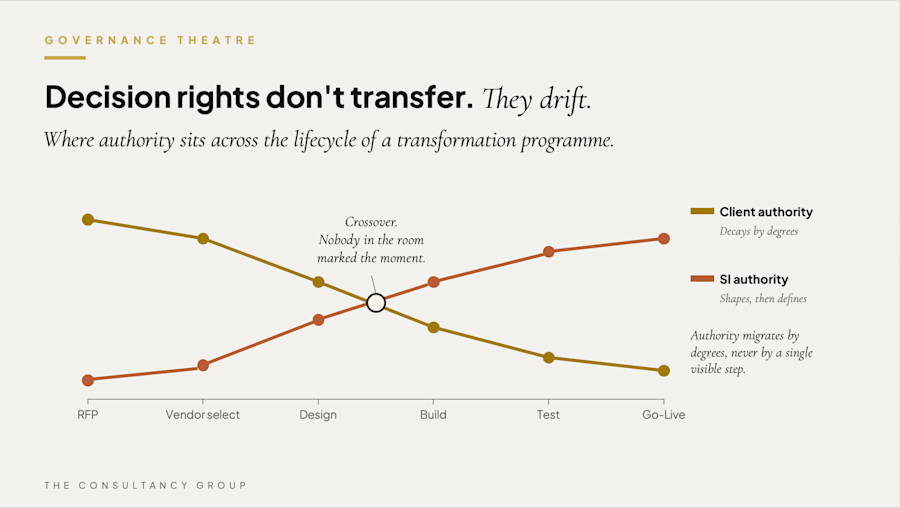
Without that person, the SI quietly shapes the solution. Once they shape the solution, they define the problem. Decision-making authority migrates from the business to the vendor by degrees, never by a single visible step. This is how the cheapest SI proposal at RFP becomes the most expensive transformation the business has ever undertaken.
Why Governance Breaks First
Boards often treat transformation as a technology problem. It is not. Transformation is a test of whether the organisation can change and keep running at the same time.
What boards underestimate is that governance is the first thing to break, not the last. It breaks because it is the easiest thing to delegate, and the hardest thing to notice failing. The SI is implementing software, which is observable. The operating P&L is being delivered, which is measurable. Governance is happening every six weeks in a Steering Committee, which looks orderly and produces minutes.
By the time governance visibly fails, the architecture is set, the budget is gone, and the operating model has already been decided by whoever was loudest in the room.
That whoever is usually the SI.
Hiring for the Scars
To protect the investment, you need a capability that sits between the board's ambition and the vendor's execution. Call it what you like: an independent Design Authority, an Interim Operating Partner, a Programme Director with delivery scars from the same kind of programme you are running.
The engagements we are typically called into share a profile. The programme is six to nine months in. The amber lights have been amber for too long. The board's confidence is starting to soften but no decision has been forced. Somebody senior has begun to suspect, privately, that the governance is performative.
The operator we place into those situations is not somebody who knows the software. SIs know the software. The operator is somebody with the commercial weight to challenge the SI, the technical fluency to validate the architecture, and the scars to recognise the failure patterns above before they become irreversible. They have run programmes from the inside. They have also, at some point, sat on the SI side of the table and know exactly how the script is written.
This is not a profile you find through traditional executive search. It is a network. It is the operators who have been in the room when the £40m programme was rescued, or, in the harder cases, when it was not.
The Real Cost of Getting This Wrong
The most expensive transformation programmes are not the ones that run over budget. Budgets can be renegotiated. The most expensive ones are the ones that quietly embed the wrong operating model into the business for the next decade. By the time the organisation realises, the SI has moved on, the executive sponsor has left, and the cost of unpicking the architecture is greater than the cost of living with it.
With PE deployment cycles tightening and the 2027 SAP cut-off forcing decisions at scale, the cost of fumbling governance now is not recoverable inside the value-creation window. The programmes being signed off this quarter are the ones that will define the next five years of operating performance.
The governance you set up around them is not theatre. It is the production.
You do not lose control of a programme at go-live. You lose it in the first three steering committees.
If you are preparing for the next phase of transformation, or you suspect a programme already underway is performing rather than progressing, this is the conversation we are having across boards and sponsors right now. We deploy the operators who step in when boardroom strategy must become ground-level execution. Get in touch.